
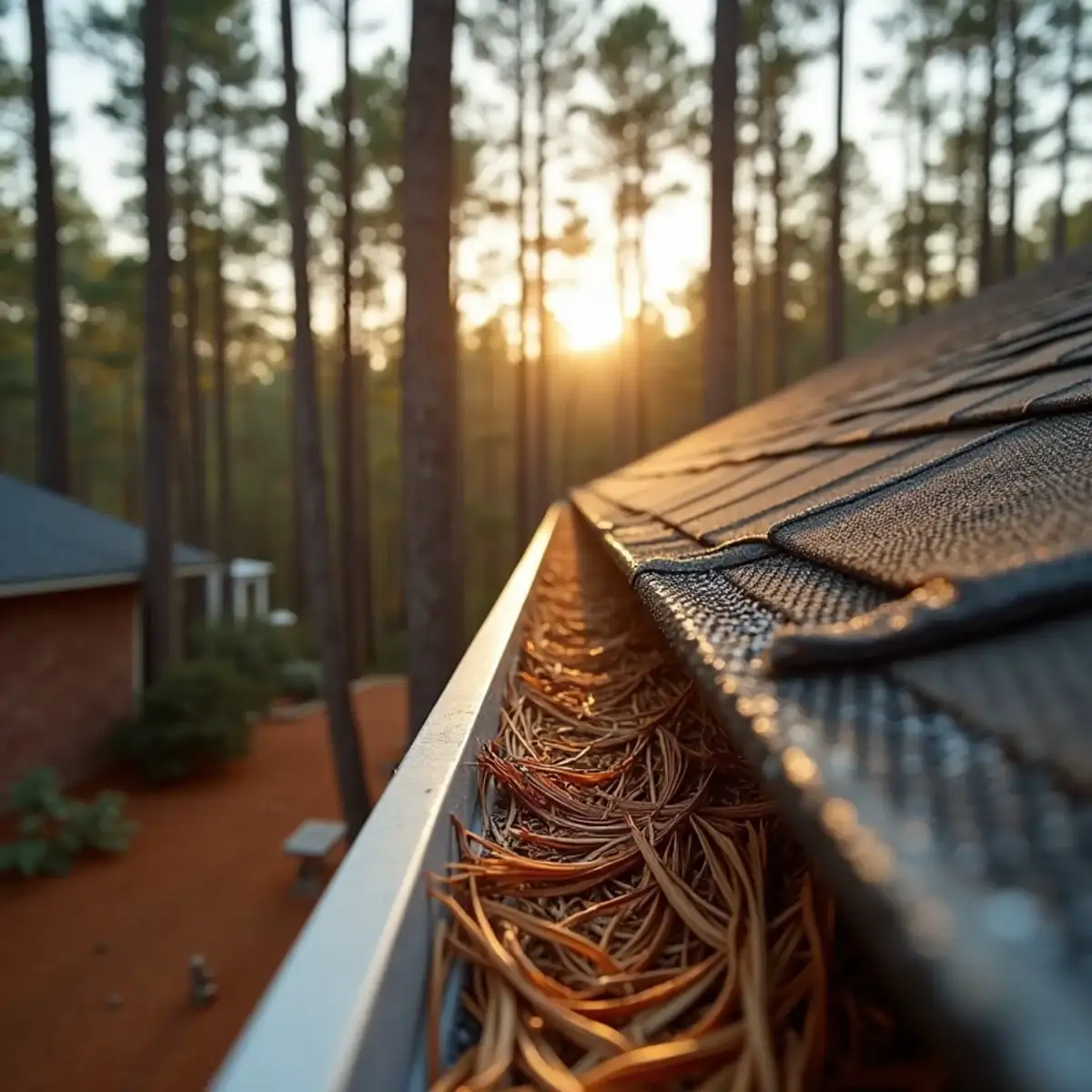
For pine needles, the best gutter guards are fine micro-mesh panels held in a rigid frame. The openings are too small for a needle to spear through, and the frame keeps the mesh from sagging into a trough that holds debris. Perforated aluminum is the next choice. Coarse screens, foam inserts and brush guards tend to fail under pines, and reverse-curve hoods are hit or miss. No guard is maintenance-free: you will still brush the surface and check outlets.
We do not sell or endorse any brand. This guide compares guard types by how they hold up under the loblolly and shortleaf pines that cover so much of the Upstate.
Why pine needles beat most gutter guards
Leaves are big and flat, so almost any guard keeps them out. Pine needles are long, thin and stiff. Loblolly needles run several inches long and shortleaf needles a little shorter, and both fall needle-first. They slide into any slot or hole wider than their own thickness, then hang there like a fishhook and catch the next ones.
Pines also shed through much of the year, with a heavy drop in fall, so the load never really stops. Around Clemson, where the 17,500-acre Clemson Experimental Forest borders town and pines line older streets and lake lots, a gutter can collect needles in every season. That steady supply is why a guard that works fine under maples can fail here within a year.
Six guard types compared for pine needles
| Guard type | How it works | Under pines | Upkeep you should expect |
|---|---|---|---|
| Micro-mesh (framed) | Fine stainless or aluminum mesh over a rigid frame | Best. Needles sit on top and blow or wash off | Brush off mats and pollen film; check outlets yearly |
| Perforated aluminum | Solid sheet punched with small holes | Good. Small holes stop most needles | Holes can fill with pollen and grit; brush as needed |
| Screens (expanded metal or plastic) | Coarse grid or diamond openings | Poor. Needles spear through and stick | Frequent pulling and cleaning |
| Reverse-curve hoods | Water follows a curved lip into a slot | Mixed. Needles can ride into the slot | Slot is hard to clean; may overshoot in downpours |
| Foam inserts | Porous foam block fills the gutter | Poor. Needles embed in the foam | Must be pulled, cleaned or replaced |
| Brush inserts | Bristle brush lies in the trough | Poor. Needles weave into bristles | Brushes come out to be cleaned |
Micro-mesh and perforated aluminum: the usual shortlist
A framed micro-mesh guard is the one most installers in pine country point people toward. The mesh is fine enough that needles cannot pass through, and the frame holds it flat and slightly pitched so debris tends to slide or blow off. Look for stainless mesh, a frame stiff enough not to dip between hangers, and a fastening method that does not depend on bending shingles up.
Perforated aluminum works on the same idea with a solid sheet instead of mesh. It is sturdy and stops most needles, but its holes are larger than true micro-mesh, so short needle tips, seed husks and shingle grit can work in over time.
Screens, foam, brush and reverse-curve: where they fall short
Plastic and expanded-metal screens are the cheapest guards and the most common ones homeowners regret under pines. The openings are wide enough for needles to drop in point-first, and once a few lodge, the screen becomes a mat that holds more debris than an open gutter would.
Foam and brush inserts sit inside the trough rather than on top. Needles and pollen embed in them, and in a humid climate the foam can grow moss and hold moisture against the metal. Both have to come out to be cleaned, which defeats the point.
Reverse-curve or hood guards rely on water following a curved lip into a narrow slot. They keep out broad leaves well, but needles can ride the water into the slot, and the slot is awkward to clear. On steep roofs in a summer cloudburst, fast water can also overshoot the curve entirely.
What to check before you choose a guard
- The gutter underneath. A guard does not fix bad slope, loose hangers, soft fascia or an undersized gutter. Those come first.
- Roof pitch. On steep roofs, the guard angle matters so water drops in rather than skating across.
- How it attaches. Guards that tuck under the first row of shingles can affect roofing work later. Guards fastened to the gutter lip or drip edge leave shingles alone. Ask your roofer if you are unsure.
- Valleys and corners. These collect the most needles and water. Ask how the guard is cut and fitted there.
- Removal. Someone will need to lift a panel now and then to check an outlet. Make sure that is possible without breaking anything.
A good starting point is a full cleaning and inspection, so the installer sees the gutter clean. Our page on gutter guards fitted to Upstate trees explains how guards are matched to existing gutters, and gutter cleaning and downspout flushing is often booked just before a guard install.
The maintenance you still need with guards
Guards change gutter cleaning from scooping wet sludge out of a trough to a lighter check of the surface and outlets. They do not end it. Under heavy pines, plan on these at minimum:
- Look at the guards from the ground after the fall needle drop and after spring pollen season.
- Brush off any needle mats or pollen film, especially at valleys and inside corners.
- Run a hose at the top of each run once a year and confirm water leaves every downspout.
- Clear the downspouts themselves. Guards keep most debris out of the trough, but fine grit still collects in elbows.
Lake homes and heavy canopy in Seneca and Anderson
The toughest guard jobs in the area tend to be lake houses. Wooded lots on Lake Keowee and Lake Hartwell put tall pines right over the roof, and walkout elevations put the back gutter two or three stories up, where cleaning by ladder is slow and risky. That is where framed micro-mesh earns its keep. If you own one of these homes, see our pages on gutter guards for lake homes around Seneca and gutter work on Anderson homes near Lake Hartwell.
Anderson’s older historic districts bring a different mix: big oaks, shorter needle loads and gutters that may need repair before any guard goes on. Every gutter installer we send is licensed where South Carolina requires it, and insured.
Expert insight: mesh material and mounting angle matter more than the brand
Two micro-mesh guards with similar names can perform very differently under loblolly pines. The details that decide it are easy to check before you buy:
- Stainless vs aluminum mesh. Both stop needles when new. Stainless mesh holds its shape and resists corrosion longer, which matters in the Upstate's humid summers. Aluminum mesh is lighter and cheaper but dents more easily under ladders and falling limbs.
- Mounting angle. A guard laid flat collects a mat of needles and pollen. A guard pitched slightly toward the front of the gutter lets rain and wind carry needles off. This is where many installs fail, not the mesh itself.
- A rigid frame. Unsupported mesh sags into the trough over a few summers and forms a pocket that holds needles and water.
- The back edge. Guards that tuck under the first course of shingles must slide in without lifting or nailing the shingles. Guards that fasten only to the gutter and fascia avoid the roof altogether.
The honest tradeoff: a well-installed stainless micro-mesh guard costs more up front than a screen. Under heavy pine canopy it usually pays for itself in skipped cleanings. Under a few young pines, a regular cleaning schedule may cost less over time.
The bottom line on gutter guards for pine needles
Under Upstate pines, fine micro-mesh in a rigid frame, mounted at a slight pitch, is the guard type that holds up. Skip foam and brush inserts, be wary of coarse screens, and fix any slope, hanger or fascia problems before a guard covers them. Then plan on a quick check each spring and fall.
To see which guard fits your gutters and your trees, call (855) 633-0442. We line up a local installer who looks at the roof edge and the canopy and quotes the guard in writing. Compare the options on our gutter guards page, or book a gutter cleaning first if the gutters are packed now.
Questions readers ask
Do micro-mesh guards clog with pine needles?
The mesh itself rarely lets needles through, but needles and pollen can collect on top, especially on low-pitch roofs and in valleys. Most of that blows or washes off. What stays forms a thin mat that a soft brush removes. Expect to check and brush the guards a couple of times a year under heavy pines, rather than scooping out a full gutter several times a year.
Are foam or brush gutter guards a good idea under pines?
Usually not. Both sit inside the gutter, and pine needles embed in them instead of sliding off. In the Upstate’s humid summers, foam can hold moisture and grow moss. To clean them you have to pull them out, which is more work than cleaning an open gutter. They can make sense on a small run under a lone hardwood, but not under a pine canopy.
Can guards go on my existing gutters?
Often, yes, if the gutters are sound. The installer should check slope, hangers, seams and the fascia first, because a guard locks in whatever problems are underneath. If the gutters are old, sagging or too small, it usually makes more sense to replace them and add guards at the same time so both are fitted together.