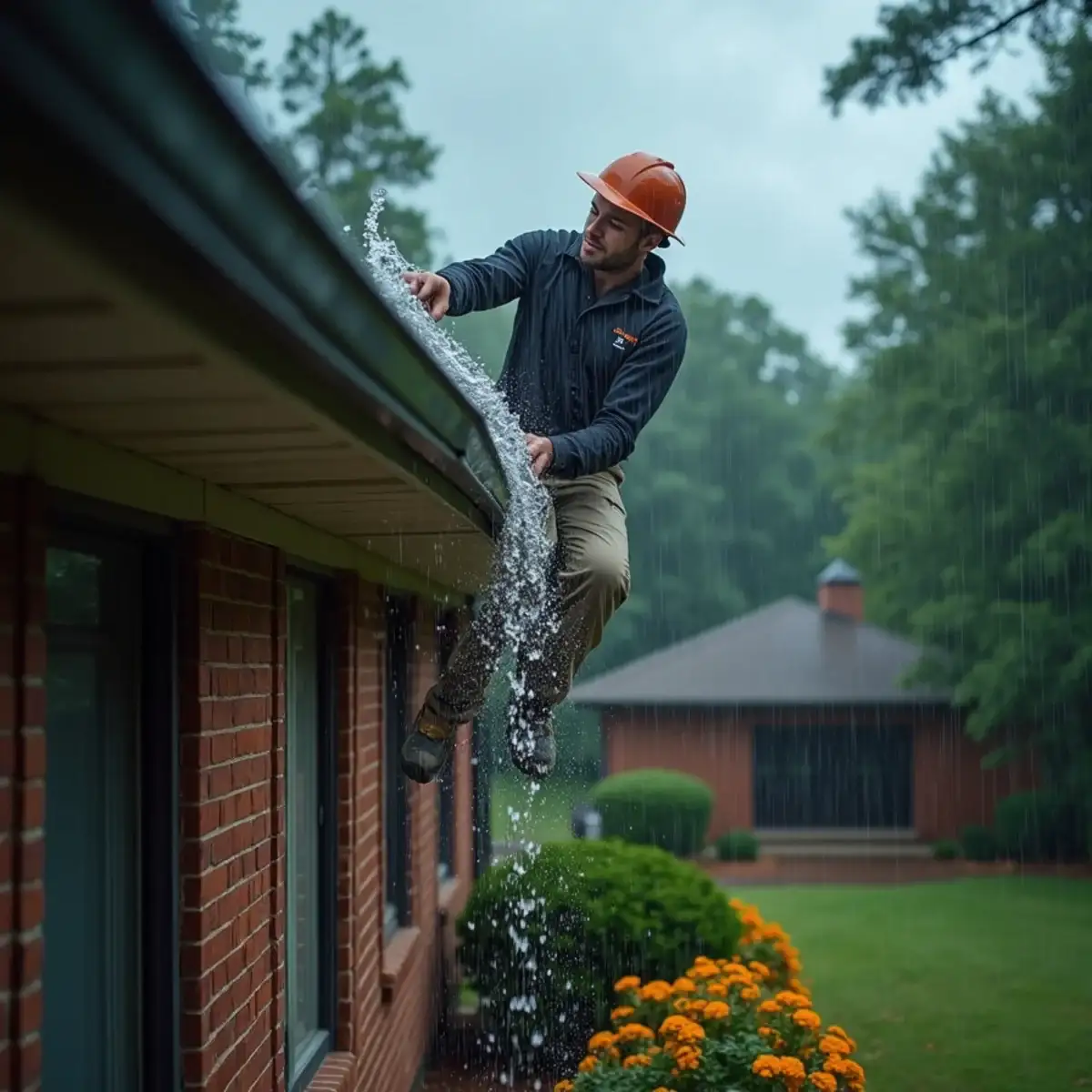
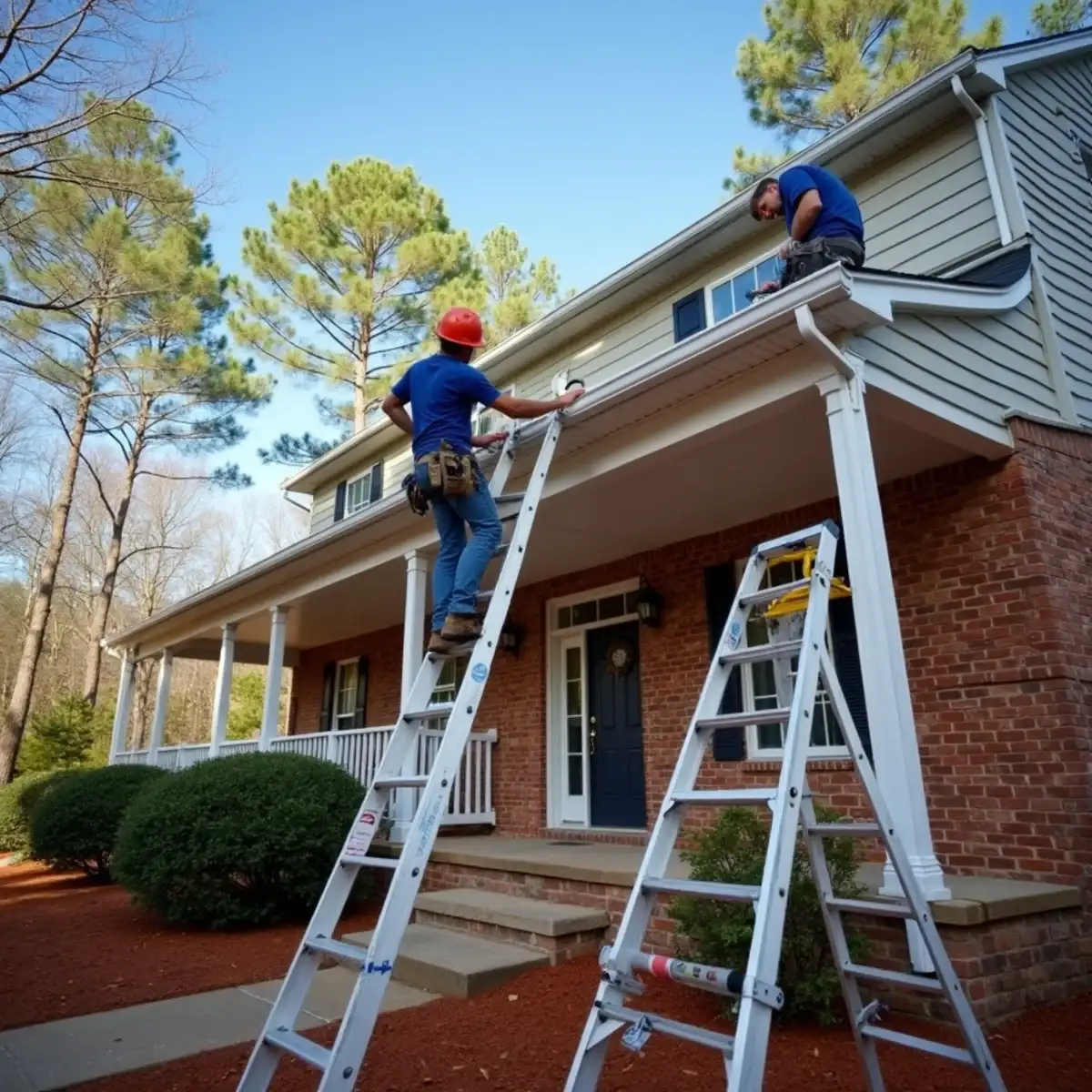
Gutter installation in Clemson, SC comes down to one job: carrying 52.4 inches of rain a year off the roof and away from red clay that won't soak it up. Call (855) 633-0442 and we line up an independent local installer who measures the house, forms seamless aluminum gutters on site and gives you a written price before work starts.
Below: when replacement beats another repair, how to size for Upstate downpours, which profiles and metals suit which houses, and the hanger, slope and outlet details that decide whether new gutters last. We handle scheduling; the installer we send does the work.
Signs your Clemson home needs new gutters, not another repair
The median Clemson home was built in 1988, so many houses in Clemson Heights, Camelot and Clemson Downs are on their first or second set of gutters. Repair one bad seam; consider gutter replacement when the same problems circle the whole house:
- Leaks at every joint. Sectional gutters join every 10 feet, and that sealant dries and cracks. Fixing one joint moves the drip to the next.
- Spikes backing out. Spike-and-ferrule hangers loosen as fascia swells and shrinks. When whole rows pull out, the run needs new hangers anyway.
- Standing water. Runs that have bowed between hangers hold water, grow algae and rust fasteners.
- Overflow when clean. If water sheets over the front in summer storms with clear gutters, the size is the problem.
- Rot behind the gutter. Peeling paint, soft fascia or streaked brick mean water has been getting behind it for years.
If only one or two apply, gutter repair for leaks and sagging runs may be the better call.
What a new gutter installation includes
A gutter installation quote should describe a finished drainage system, not just a length of aluminum. On a typical Clemson job, the installer we send handles every piece of this list. Each one should appear on the written quote before you approve it.
- Measuring every run and marking where each downspout goes, based on roof area and where the water should leave the yard.
- Taking down and hauling off the old gutters, spikes and brackets, shown on the quote as its own line.
- A fascia check before anything is hung. Soft or split boards are pointed out and priced first; see soffit and fascia repair.
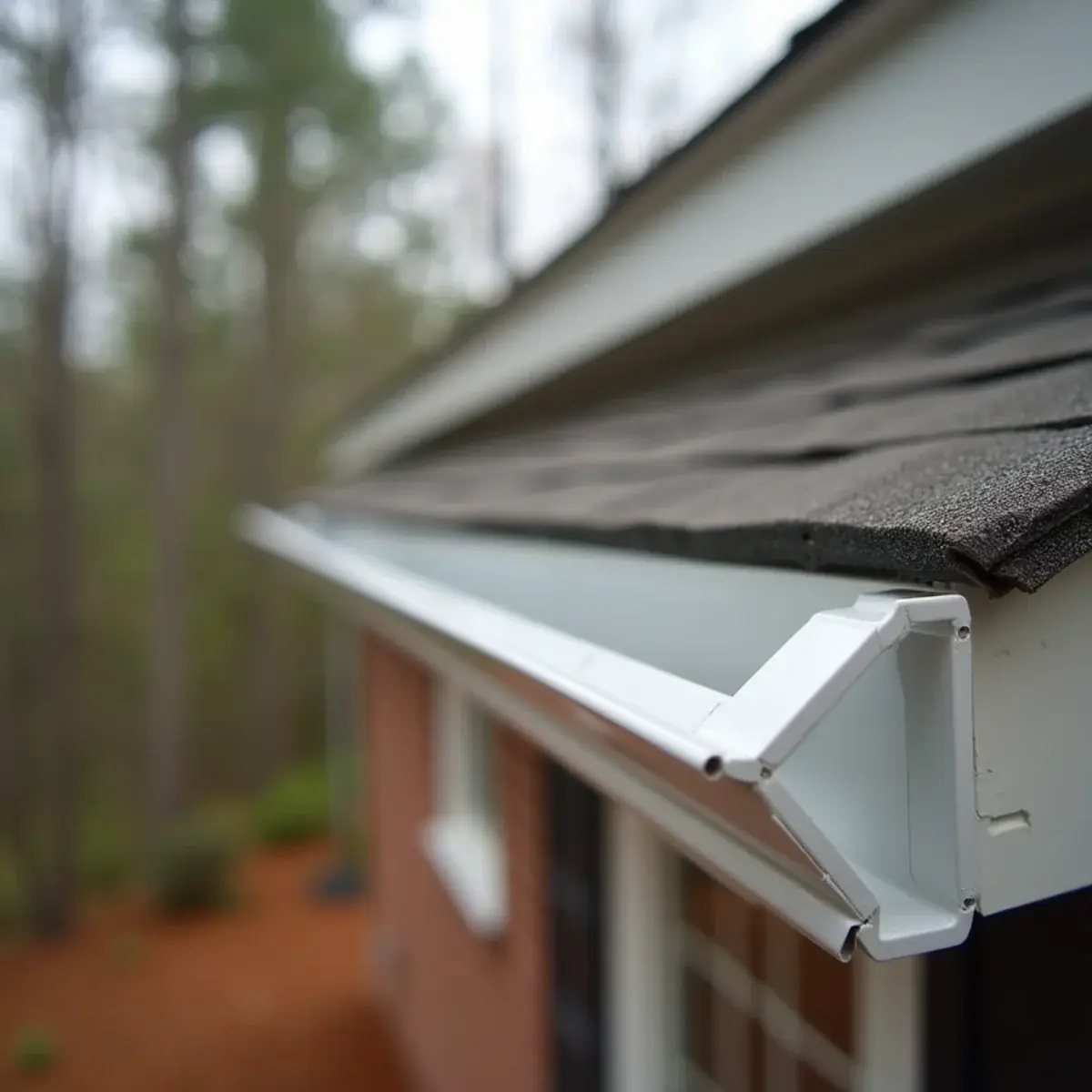
- Seamless runs formed on site from coil, with corners mitered and sealed, and end caps crimped and sealed.
- Screw-in hidden hangers with corrosion-resistant fasteners, spaced for the gutter size, so the run holds a steady slope toward the outlets.
- Outlets, downspouts and elbows sized to the roof, plus extensions or splash blocks so water lands away from the foundation.
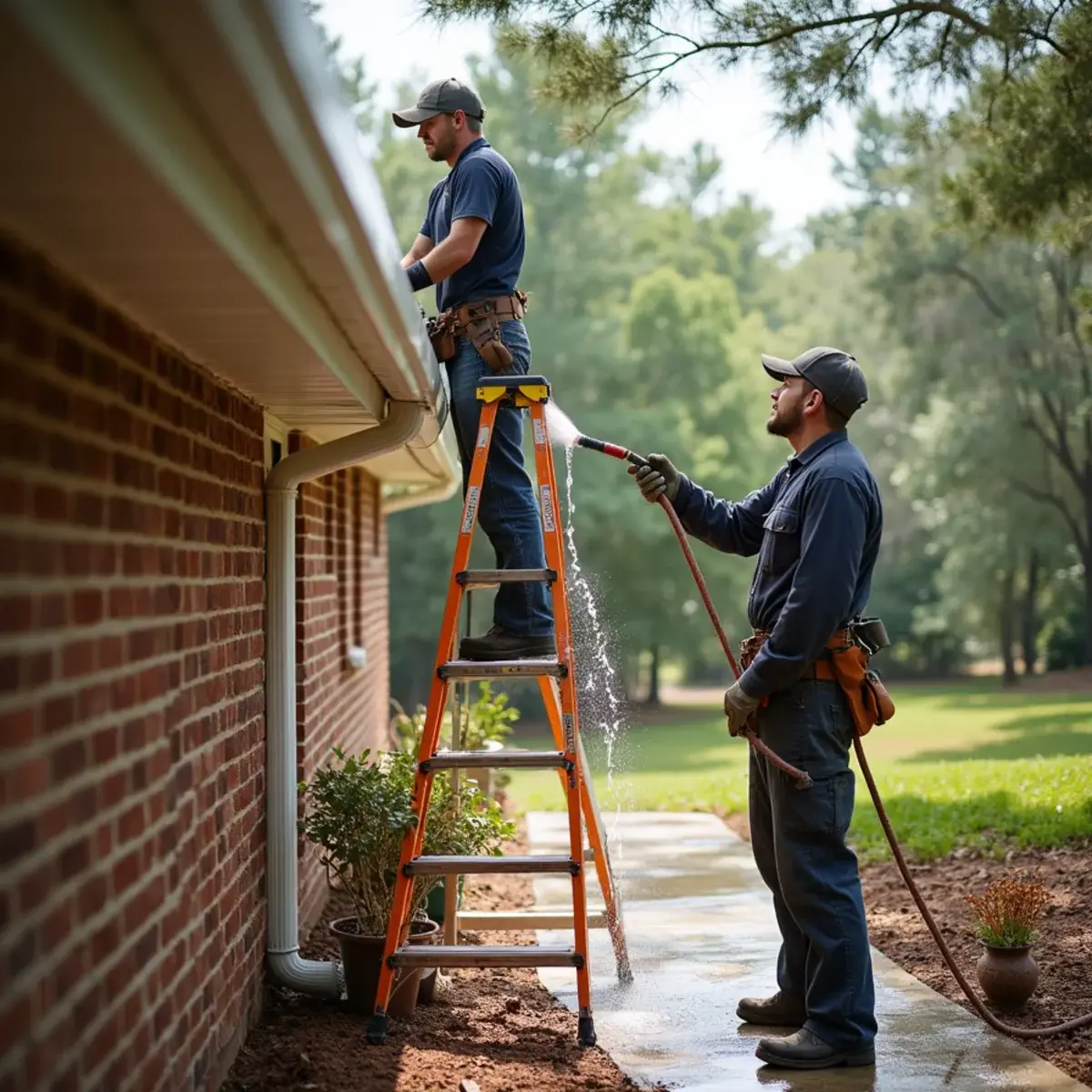
- Cleanup and a hose test at the end, so you can watch the water run to each outlet and out of each downspout.
- The warranty in writing: workmanship from the installer, finish and material from the manufacturer.
Gutter guards and buried drain lines are optional add-ons. If you want them, ask for them on the same quote so they are sized together; our gutter guards and downspout drainage pages explain both.
Seamless aluminum gutters: formed on site to the length of each roofline
A forming machine on a trailer in your driveway rolls painted aluminum coil into gutter. The installer measures each roofline and cuts one continuous piece to fit, so a 42-foot run across the back of a ranch becomes a single 42-foot gutter.
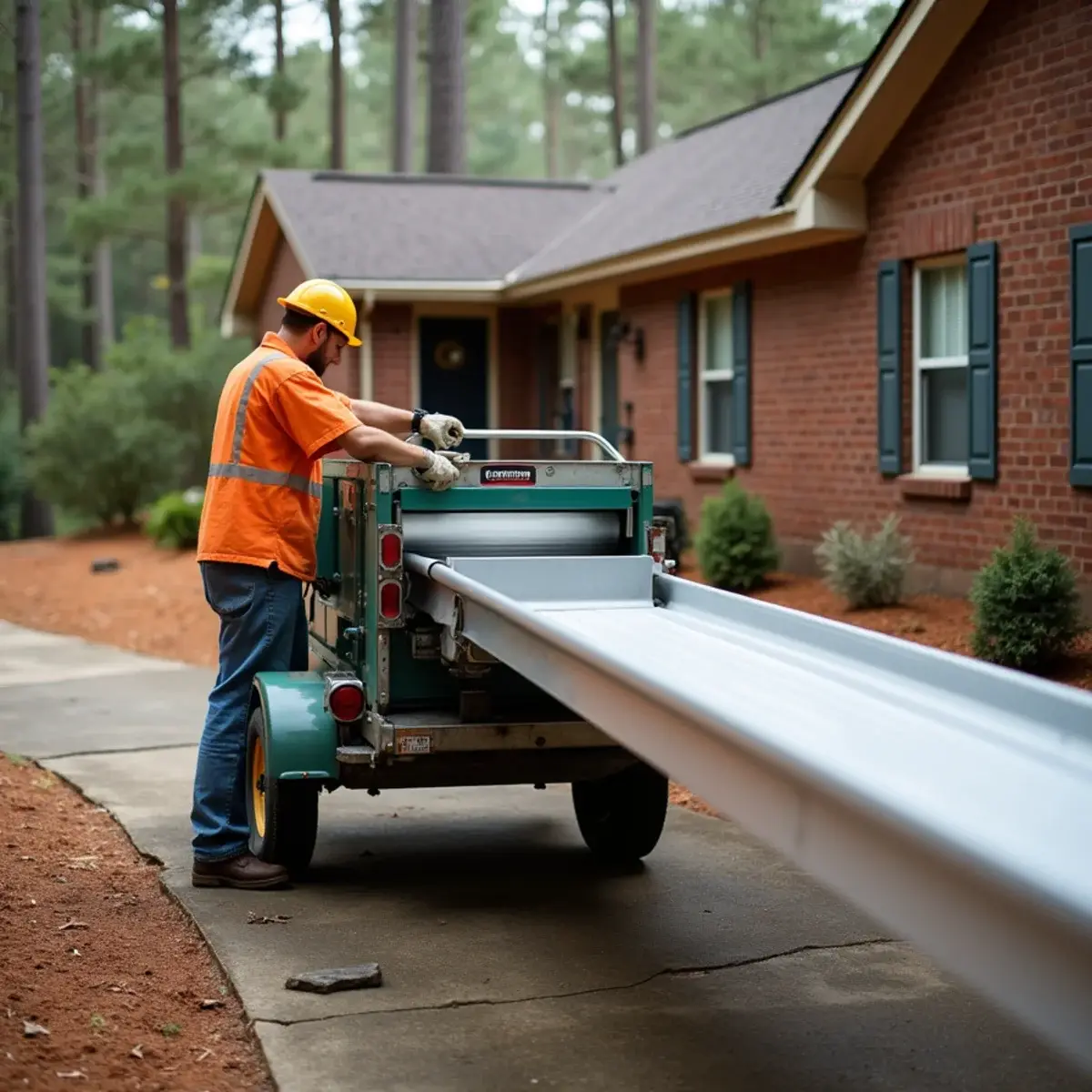
The only seams left are the necessary ones: corners (miters), end caps and outlets, each riveted and sealed. Fewer joints means fewer leaks, which is why seamless gutters have replaced sectional runs on most Upstate homes.
5-inch or 6-inch: sizing gutters and downspouts for 52 inches of rain a year
How hard rain falls matters more than the yearly total. A foothills thunderstorm can drop an inch in well under an hour. Sizing depends on how much roof drains into each gutter, how steep it is, and how many downspouts serve the run.
A 6-inch K-style gutter holds roughly 40% more than a 5-inch and pairs with 3x4 downspouts, which carry about twice what a 2x3 does and are far harder for pine needles to plug. Go 6-inch for runs over about 40 feet with one outlet, steep or two-story roofs, valleys that pour two roof planes into a short stretch, and lake homes under tall pines.
| Setup | Typical fit | Watch for |
|---|---|---|
| 5-inch K-style + 2x3 | Single-story ranch, short runs | Valley overflow; clogs under pines |
| 5-inch K-style + 3x4 | Ranch with long runs or heavy trees | Good middle step |
| 6-inch K-style + 3x4 | Two-story, split-level, steep or lake homes | Needs solid fascia, closer hangers |
| 6-inch half-round + round | Historic and period homes | Holds less; add downspouts |
K-style, half-round and box profiles, and which suit ranch, split-level and lake homes
K-style gutters have a flat back and a crown-molding front. They mount flush to fascia and are the default on brick ranches and split-levels. Half-round gutters hang on brackets with round downspouts and suit period trim, which is why they come up on older and historic homes in Pendleton. Box gutters are large rectangular troughs for commercial buildings or a wide low-slope porch.
- Brick ranch on a wooded lot: 5-inch K-style, or 6-inch if pines overhang the roof.
- Split-level: K-style, with upper downspouts piped to the lower gutter so they don't blast over it.
- Lake home with a walkout: 6-inch with 3x4 downspouts routed away from the downhill wall, common on seamless gutter installs in Seneca near Lake Keowee.
- Mill-era cottage: half-round or 5-inch K-style; many in Central never had a full set, see first-time gutter installs in Central.
Installers we send cover every town on our gutter service areas around Clemson page.
Aluminum, copper and steel: materials, gauges and colors
| Material | Strengths | Trade-offs |
|---|---|---|
| Aluminum, .027 | Light, rust-free, residential standard | Dents from ladders and limbs |
| Aluminum, .032 | Stiffer on long runs and 6-inch | Ask whether it is quoted |
| Copper | Very long life, patina, historic look | Specialty work, matched fasteners |
| Galvalume steel | Strong, dent-resistant | Rusts at cuts and scratches |
For most Clemson houses, .032 aluminum gutters are worth asking about: they flex less under wet pine needles and survive a ladder lean. When you compare gutter installers near you, have each write the gauge on the quote. Coil comes in many colors; most owners match the trim or brick. Copper gutters are quoted as specialty work.
Hangers, slope and outlets: what separates a good install from a leaking one
- Hidden hangers, screwed in. Fastened through the fascia into rafter tails where possible, about every 24 inches, or 16 to 18 inches under heavy pines and on 6-inch gutters.
- Slope. About 1/4 inch of fall per 10 feet. Runs over about 40 feet are often pitched from the middle to an outlet at each end.
- Outlets near valleys. A missing valley outlet is the most common reason new gutters overflow at one corner.
- Drip edge or gutter apron. The gutter's back tucks under it so roof water can't run behind the gutter.
- Downspouts carried away. Each one strapped to the wall and ending in an extension or drain line, not dumping at a crawl space corner on red clay.
Install day step by step: tear-off, fascia check, forming, hanging, water test
- Tear-off. Old gutters, spikes and downspouts come down.
- Fascia check. Soft boards are replaced or wrapped first; see fascia repair before new gutters.
- Forming. Each run is measured, formed and fitted with miters, end caps and outlets on the ground.
- Hanging. A chalk line sets the slope and each run is fastened.
- Downspouts. Cut, strapped and fitted with elbows and extensions.
- Water test. A hose at the high end shows the run drains and the corners stay dry. Old metal is hauled away.
Warranty terms come from the installer and are written into your quote, so ask for them before you sign.
What affects the cost of new gutters
- Linear feet of gutter and downspout
- Size and gauge: 5-inch or 6-inch, .027 or .032
- Profile and metal: K-style aluminum, half-round or copper
- Corners, outlets and downspout count
- Height and access: two-story walls, walkouts, steep lots, decks
- Tear-off, disposal and any fascia repair found
- Add-ons such as guards or buried drain lines
Read what new gutters cost in Clemson for how these factors add up, and why gutters overflow in heavy rain to tell a sizing problem from a clog. Want covers too? Ask for gutter guards installed with the new gutters on the same quote.
Why Clemson homeowners book gutter installation through Repel Dry Gutter Pros
- Sized for Upstate rain, not a catalog default. Installers look at roof area, valleys and pitch before choosing 5-inch or 6-inch gutters and 2x3 or 3x4 downspouts, then confirm it with a hose test.
- A price before work starts, line by line. You see the linear feet, size, color, downspout count, removal and any fascia work before anyone climbs a ladder.
- Straight answers about the fascia. If the boards behind the old gutters are soft, you hear it before new gutters go up, not after they start pulling loose.
- Insured installers, licensed where South Carolina requires it. Every gutter installer we send is licensed where South Carolina requires it, and insured. Ask for the certificate; it is a normal request.
- Gutters only. We do not sell roofs or siding. The call is about the gutter system and the water it carries.
Gutter installation across Clemson and nearby towns
Installers we work with hang new gutters across Clemson, from the 1970s ranches in Clemson Heights and Camelot to the newer homes in Clemson Downs and the lake houses on the Lake Hartwell side. They also cover the towns within about 30 minutes, and each brings its own kind of installation job:
- Seneca: tall walkout-basement lake homes near Lake Keowee, where long runs and heavy pine canopy usually call for 6-inch gutters and 3x4 downspouts.
- Central: older houses near downtown that never had a full set of gutters, plus rental houses that need durable, simple systems.
- Pendleton: historic homes where half-round profiles and careful downspout placement suit the house better than a standard K-style swap.
- Easley: newer subdivisions where builders left gutters on the front only, and mill-era houses near downtown.
- Anderson: early-1900s homes in the historic districts and Lake Hartwell homes west of the city.
Not sure your street is covered? The service areas page lists every town, including Liberty, Six Mile and Walhalla on request.
Gutter Installation questions from Clemson homeowners
How long does a gutter installation take on a typical Clemson house?
Most single-family houses are a one-day job once the installer is on site: tear-off first, forming and hanging through the middle of the day, then downspouts and a water test. Large two-story or lake homes with many corners, or jobs where rotted fascia must be replaced first, can run into a second day. When the visit can be booked depends on the season and the installer's schedule; fall leaf season and the weeks after storms are busiest.
Are 6-inch gutters worth it in the Upstate?
On many houses, yes. Clemson averages 52.4 inches of rain a year, and summer storms deliver it in hard bursts. A 6-inch gutter holds roughly 40% more than a 5-inch and pairs with 3x4 downspouts that move more water and clog less with pine needles. It pays off on two-story walls, steep roofs, long runs, valleys and lake homes. On a small ranch with short runs and enough downspouts, 5-inch usually does the job.
Can new gutters go on if the fascia is soft or rotted?
They shouldn't. Hangers screwed into soft wood pull out once the gutter fills with water and wet needles, and the new gutter starts sagging within a season or two. A careful installer checks the fascia during tear-off and flags soft sections, which are replaced, and often wrapped in aluminum, before the new gutters go up. Ask for any fascia work to be listed on the written quote.
Are the installers licensed and insured in South Carolina?
Every gutter installer we send is licensed where South Carolina requires it, and insured. Licensing depends on the type and size of the job, and you are welcome to ask the installer for proof of insurance before work starts. Repel Dry Gutter Pros handles the scheduling; the independent local installer we send does the work and puts the price in writing first.
How long do seamless aluminum gutters last?
Aluminum gutters that are hung on sound fascia and cleaned regularly commonly last 20 years or more. Copper lasts far longer, while vinyl and thin sectional runs wear out sooner. Around Clemson, what shortens a gutter's life is usually not the metal. It is loose hangers, rotted fascia and debris that sits wet under the pines, so cleaning and a sound fascia matter as much as the material.
What is the difference between seamless and sectional gutters?
Sectional gutters come in 10- or 20-foot pieces joined with seams along the run, and those seams are where most leaks start. Seamless gutters are formed on site from a coil to the full length of each roofline, so the only joints are at the corners and end caps. That means fewer places to leak and a cleaner look. Most installation quotes around Clemson are for seamless aluminum.
Reviewed by the Repel Dry Gutter Pros team · Last updated