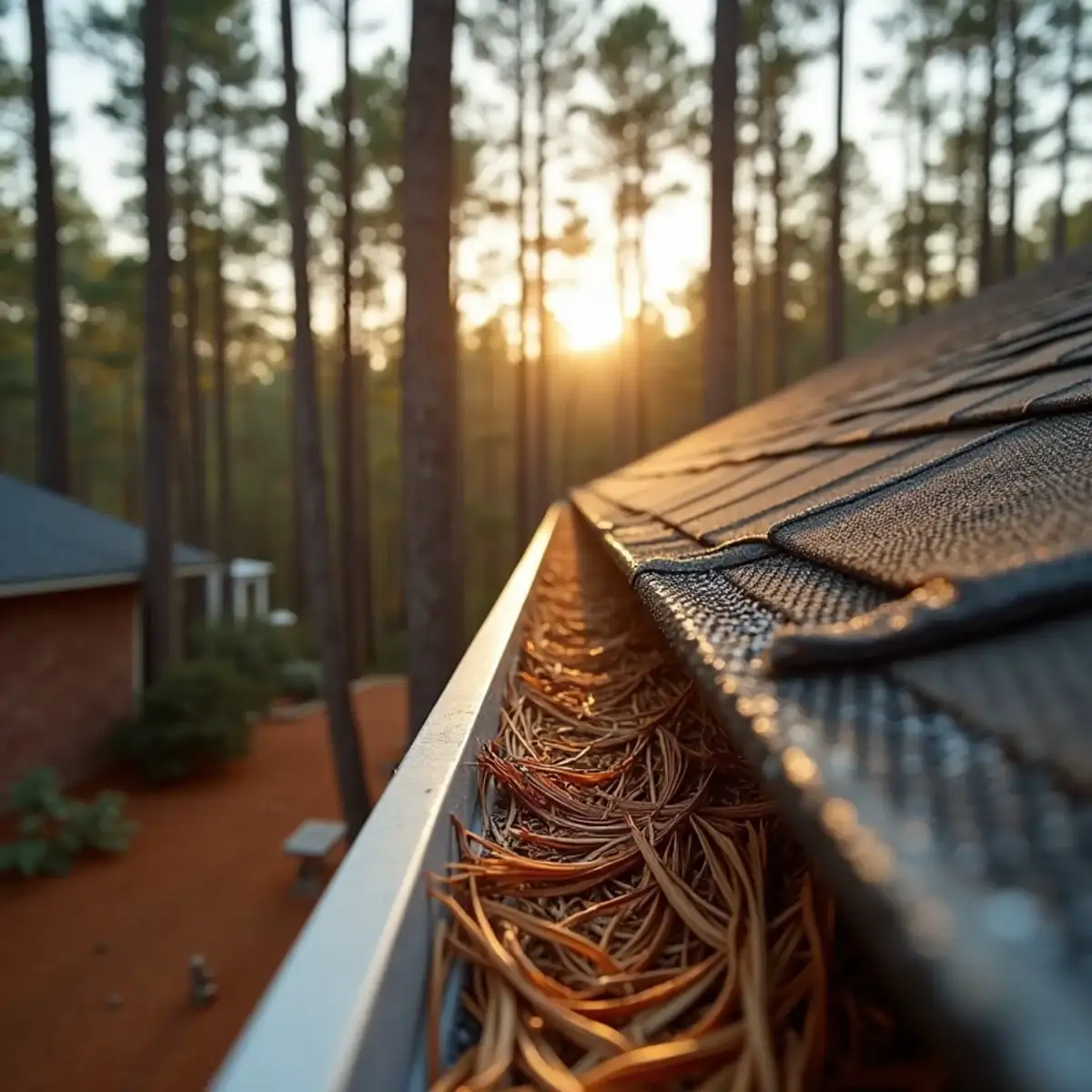
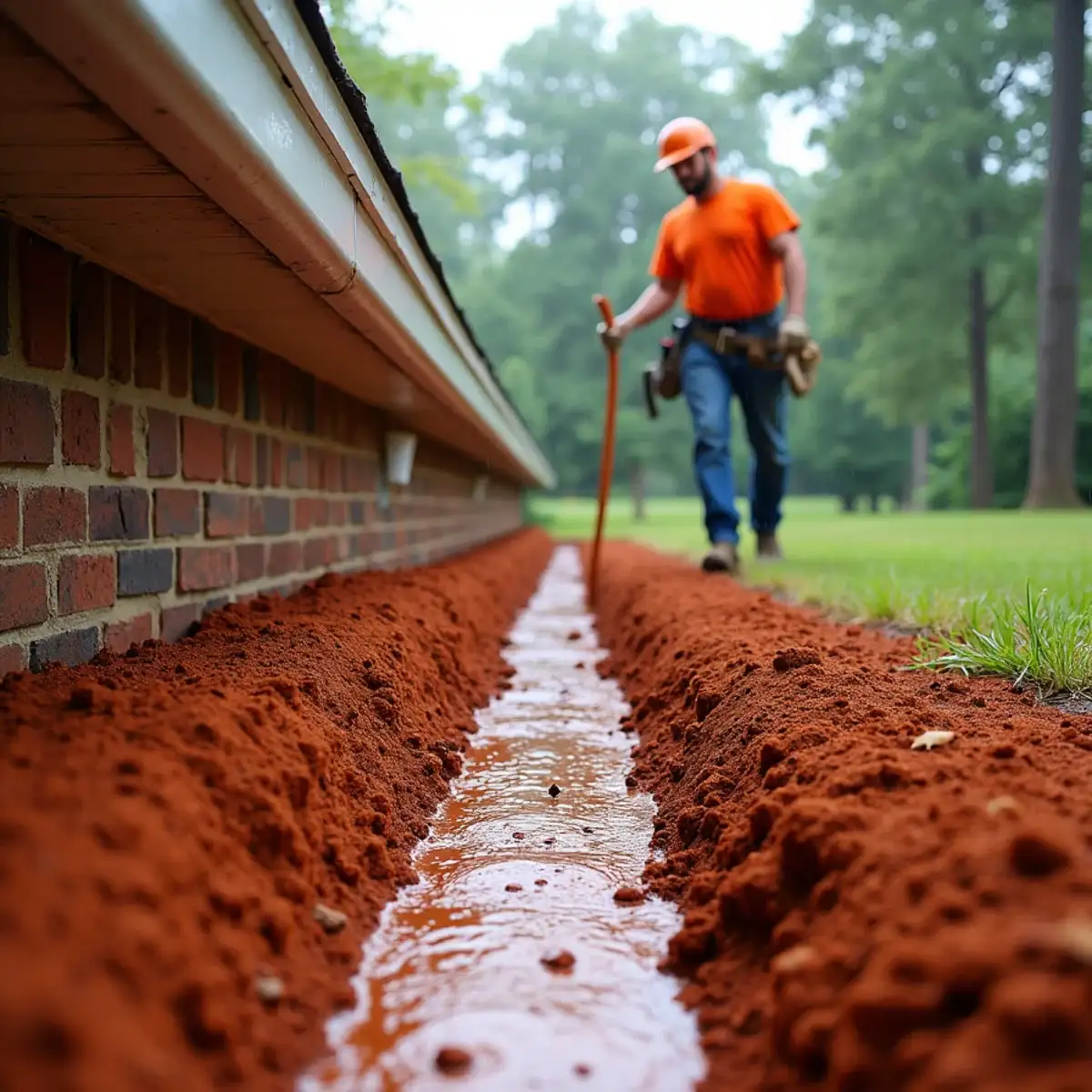
Downspouts on red clay soil need to carry roof water well away from the house, usually 4 to 10 feet or more, and release it where the ground slopes downhill. Clay barely absorbs water, so a downspout that empties at the foundation leaves a puddle that runs back toward the wall, cuts a washout in the bed and soaks the crawl space. The fix is almost always a better outlet: longer extensions, a buried solid pipe to a lower spot, or more downspouts so no single one carries too much.
Around Clemson, a hard summer storm can drop an inch of rain in an hour, and an inch on a 2,000-square-foot roof is roughly 1,250 gallons headed for a handful of downspouts. Here is how that water behaves in Upstate clay and which fixes hold up.
Why red clay turns roof water into a foundation problem
The red in Upstate soil comes from iron oxides in a dense, fine-grained clay. Its particles pack tight, so water soaks in slowly and runs off quickly. Sandy soil swallows a downspout’s flow within a few feet. Clay sheds it.
There is a second problem right next to the house. The trench around a foundation is backfilled with loosened soil that takes water far more readily than the undisturbed clay beyond it. Water from a short downspout collects in that looser band like a bathtub and sits against block or brick walls for days. That is how a crawl space stays damp in a dry week.
Clemson gets about 52.4 inches of rain a year, much of it in short, hard summer bursts.
Signs your downspouts are dumping water in the wrong place
Clay leaves evidence. Walk the house after a good rain and look for these:
- A gully or bare fan of soil at the foot of a downspout, with pine straw or mulch washed into the lawn.
- Orange-red splash marks on the lower siding or brick, up to a foot or two high.
- Standing water that stays near the wall a day or more after the rain stops.
- A musty smell from crawl-space vents, sagging insulation under the floor, or white mineral crust on block piers.
- Silt in the gutter outlet or a downspout elbow packed with mud, a sign water is backing up at the bottom.
How far a downspout should discharge on a clay lot
Common guidance is to release roof water at least 4 to 6 feet from the foundation. On Upstate clay, aim further, and mind direction as much as distance: five feet pointing downhill beats ten feet pointing at a high spot.
| Option | Where it works | Watch out for |
|---|---|---|
| Splash block | Lots that already fall away from the house | Too short on its own for flat or back-sloped yards |
| Above-ground extension (4–10 ft) | Side yards and beds with a clear downhill run | Mowers, kids and cars knock them loose |
| Flip-up or hinged extension | Downspouts beside a lawn that gets mowed | Has to be put back down after mowing |
| Buried solid PVC to a daylight outlet | Lots with a lower spot, ditch or slope edge to drain to | Needs steady fall the whole length |
| Buried pipe to a pop-up emitter | Flat lawns with some fall toward the emitter | Clay will not absorb the water at the emitter; it must run off from there |
The ground itself matters too. A widely used building-code guideline is soil that falls about 6 inches over the first 10 feet away from the foundation. Many older lots have settled flat or tilt back toward the house, and no extension fully makes up for that.
Buried drain lines and pop-up emitters: what works in clay
A buried downspout drain is the cleanest fix when an extension is in the way or keeps getting knocked off. The details decide whether it lasts.
- Use smooth-wall solid PVC, not black corrugated pipe. Clay silt settles in the ribs of corrugated pipe, and the thin wall can crush under a mower or car tire.
- Keep a steady fall from end to end. A sag in the line holds water, then mud, then clogs.
- End at daylight where you can. On a sloped lot, the best outlet is open air on the downhill side, where water spills onto grass or rock.
- Treat emitters as an exit, not a drain. A pop-up emitter in clay only works if the ground around it falls away. Set on flat clay, it leaves a soggy patch and a pipe that stays full.
- Add a cleanout. A capped fitting near the downspout lets a clog be flushed without digging up the line.
One more rule: never tie downspouts into a foundation or footing drain. Feeding roof water into those perforated pipes sends it right back to the walls. The downspout and drainage service covers extensions, buried lines, emitters and clearing clogged underground runs.
Sloped lots, crawl spaces and walkout basements
Much of the Clemson area sits on rolling foothill ground, so houses have an uphill side that catches the most surface water. On split-levels and walkouts, the low wall is often a finished room, so a wet wall there costs more than a wet crawl space.
Older houses add their own wrinkle. In Pendleton’s historic homes, crawl spaces sit on brick piers with deep eaves above, and downspouts were often placed for looks, not drainage. Moving an outlet or two and piping the water to the low corner can dry a crawl space without changing the front.
New subdivisions have the opposite problem. Builders spread thin topsoil over packed clay and sometimes leave partial gutters or downspouts that end at the slab. In newer Easley neighborhoods, those first few years before the lawn fills in are when washouts and silt-stained siding show up.
When the downspout itself is the bottleneck
Sometimes the outlet path is fine but one downspout is draining too much roof. A standard 2x3 downspout on a long run or below a valley can back up in a hard storm and spill at the corner. Upsizing to 3x4 or adding an outlet splits the load. That work often goes with gutter installation and replacement when the gutters are on their second set anyway.
Quick fixes that make clay drainage worse
Some common fixes for a wet corner add to the problem on clay:
- Piling mulch or pine straw higher against the wall. It hides the washout but holds water against the foundation and gives termites a bridge.
- Digging a gravel pit (dry well) at the downspout. In clay, a gravel hole fills and stays full because the water has nowhere to go.
- Aiming the water at a driveway or neighbor’s yard. It moves the problem instead of solving it.
- Ignoring the gutter above. A clogged or poorly sloped gutter overflows along its length, so water lands everywhere except the downspout.
If water spills over the front of your gutters in a storm, read why gutters overflow in heavy rain first. Fixing the gutter may solve the ground problem.
Expert insight: check the grade before you bury pipe
Installers who fix drainage on Upstate clay lots look at the ground right against the house before deciding on extensions or buried lines. A few things they check:
- The first 10 feet. Ground should drop roughly 6 inches over the first 10 feet out from the foundation. Backfill around older houses settles over the years, and a dip against the wall catches water no matter where the downspout ends.
- Mulch and bed edging. Raised beds and thick mulch piled against the brick can act like a dam that holds water at the wall. Pulling mulch back a few inches from the foundation sometimes does as much as a new extension.
- Shrink and swell. Clay swells when it is soaked and shrinks in dry spells. Keeping water off the soil next to the foundation keeps that cycle gentler on the walls and slab.
- Where the water goes next. Carrying water 10 feet out only helps if it keeps running downhill from there, not back toward the house or onto a neighbor's lot.
The tradeoff: a buried line with a pop-up emitter is tidy and mower-proof but costs more and can clog if it is laid without steady fall. A long extension is cheap and easy to inspect but gets kicked loose. Regrading a low spot can be the cheapest fix of all when the problem is the ground, not the downspout.
The bottom line on downspouts and red clay
Red clay turns every short downspout into a foundation problem, because the water has nowhere to go but sideways along the wall. Get each downspout's water 4 to 10 feet out onto ground that keeps falling away, fix any low spot right against the house, and choose extensions, splash blocks or buried lines based on how the yard is used.
If water pools at your foundation or your crawl space stays damp after rain, call (855) 633-0442. We line up a local installer who traces every downspout and quotes downspout and drainage work in writing, from a simple extension to a buried line. If the gutters themselves are spilling, start with gutter repair.
Questions readers ask
How far should downspouts discharge from the foundation in clay soil?
At least 4 to 6 feet, and further where the lot allows. On Upstate red clay, direction matters as much as distance: the water should come out where the ground keeps falling away from the house. If the yard is flat or slopes back toward the wall, a buried solid pipe to a lower spot usually does better than a longer above-ground extension.
Do pop-up emitters work in red clay?
They work as an outlet, not as a way to soak water into the ground. Clay absorbs very little, so the emitter has to sit where the ground falls away and water can run off. Where the lot allows, a daylight outlet on a slope is usually the better choice.
Can fixing downspouts dry out a damp crawl space?
Often it helps a great deal, because short downspouts are one of the most common sources of crawl-space water on clay lots. If the crawl space stays wet after the downspouts are corrected, the cause may be grading, groundwater or plumbing, and that needs a separate look.